
How a Modern Steel Pipe Mill Works: Process and Technology Explained
The production of welded steel pipe is a fundamental process in modern metal fabrication. At the center of this operation is the steel pipe mill, an integrated manufacturing line that transforms flat steel strip into strong, precise cylindrical pipes. This technology enables the high-volume production essential for construction, infrastructure, and industrial applications worldwide.
Understanding how a steel pipe mill functions is crucial for manufacturers aiming to improve efficiency and product quality. The process combines mechanical forming with advanced welding to create a seamless final product. Leading equipment providers like SANSO design and build these complex systems to meet the demanding requirements of global markets.
What is a Steel Pipe Mill and Its Primary Function?
A steel pipe mill is a continuous production line designed to manufacture longitudinally welded pipes. It takes raw material—typically coiled steel strip—and processes it through a series of stages to form, weld, and finish pipes of specific diameters and wall thicknesses.
The Core Manufacturing Objective
The primary goal is to produce consistent, high-quality welded pipe efficiently. The mill must maintain tight dimensional tolerances and create a strong, reliable weld seam along the entire pipe length.
Key production targets include:
- High throughput with consistent quality.
- Minimal material waste and optimal yield.
- Adaptability to different pipe specifications.
- Compliance with international quality standards.
The Step-by-Step Production Process in a Mill
Operating a steel pipe mill involves a precise sequence of operations. Each stage prepares the material for the next, creating a smooth, continuous flow.
1. Coil Loading and Entry Processing
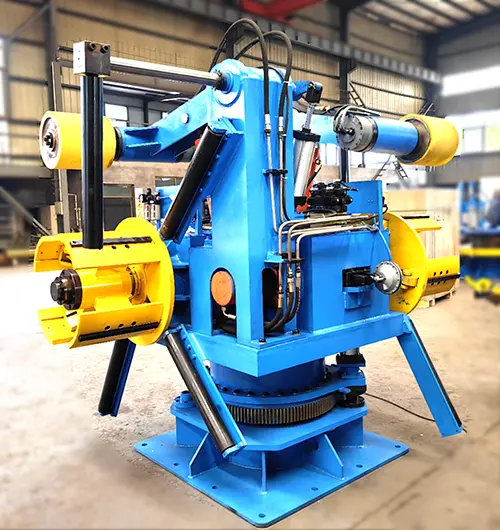
The process begins with a decoiler that holds and unwinds the master steel coil. The strip passes through a leveling machine to remove coil curvature and ensure flatness. Edge trimming may occur here to achieve the exact width required for the target pipe diameter.
2. Forming the Pipe Shape
This is a critical mechanical stage. The flat strip travels through a series of contoured roll stands. Each set of rolls gradually bends the strip until its edges meet.
- Initial rolls create a "U" shape.
- Intermediate rolls close the "U" into an "O".
- Final forming rolls bring the edges together perfectly for welding.
3. Welding the Longitudinal Seam
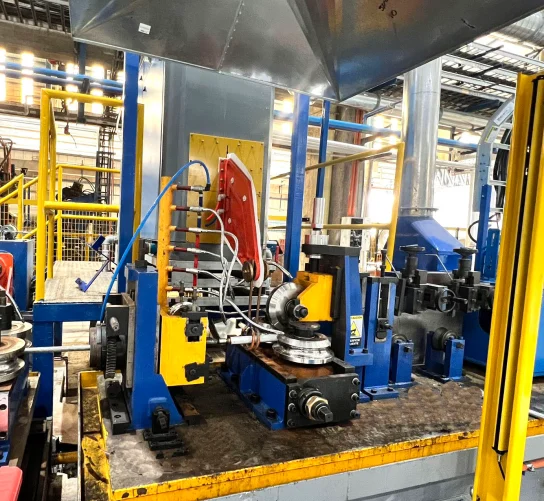
Once the edges are aligned, they are welded together. High-Frequency (HF) Induction or Contact Welding is the most common method for carbon steel pipes. It heats the edges to a molten state and forges them together under pressure, creating a strong bond without filler material.
4. Sizing and Final Processing
The welded pipe passes through sizing stands to calibrate its exact outer diameter and roundness. It is then cooled. A flying cut-off saw cuts the continuous pipe to predetermined lengths without stopping the production line. The finished pipes are then ejected for bundling or further processing.
Key Technologies in Modern Pipe Mills
Technological advancements have significantly improved the efficiency and capability of the modern steel pipe mill.
High-Frequency Welding Technology
HF welding is the industry standard for most structural and mechanical pipes. It is fast, efficient, and produces a clean weld. The technology allows for high travel speeds and excellent weld integrity.
Digital Control and Automation Systems
Modern mills are controlled by sophisticated PLC (Programmable Logic Controller) systems. These manage line speed, welding parameters, and cut lengths. Automation reduces human error and allows for precise repeatability. Touch-screen HMIs (Human-Machine Interfaces) provide operators with real-time data and control.
Manufacturers like SANSO integrate these advanced controls to enhance the performance and user-friendliness of their steel pipe mill offerings.
Quality Assurance and Monitoring
Integrated systems monitor the weld quality in real-time. Ultrasonic or eddy-current testing devices can be installed inline to detect flaws without slowing production. This ensures every meter of pipe meets the required specifications.
Applications of Pipes Produced by These Mills
Pipes manufactured on a steel pipe mill serve a vast array of industries due to their strength, durability, and versatility.
Construction and Infrastructure
This is the largest application sector. Pipes are used for structural columns, building frames, scaffolding, and handrails. Larger diameter pipes are essential for piling and foundation support.
Fluid and Gas Conveyance
While not for high-pressure transmission, welded pipes are used for water lines, drainage, and low-pressure gas distribution in municipal and industrial settings.
Mechanical and Manufacturing
Pipes form the basis for machinery frames, conveyor systems, agricultural equipment, and automotive components. Their hollow structure provides an excellent strength-to-weight ratio.
- Furniture and architectural applications.
- Fencing and greenhouse structures.
- Wind turbine towers and solar panel supports.
Important Considerations for Mill Operation and Investment
Running a successful pipe production facility requires attention to several operational and business factors.
Selecting the Right Mill Specifications
Match the mills capabilities to your product plan. Key specs include the range of pipe diameters, wall thicknesses, material grades, and maximum production speed. Over-specifying can lead to unnecessary cost, while under-specifying limits business growth.
Maintenance for Longevity and Precision
Regular maintenance is non-negotiable. A proper schedule ensures consistent product quality and prevents costly breakdowns.
- Daily: Lubrication, cleaning, visual inspections.
- Weekly: Checking roll alignment and wear.
- Monthly: Inspecting welding components and calibrating sensors.
- Annually: Major overhaul of critical components.
Training and Skilled Operation
The complexity of a modern steel pipe mill demands trained personnel. Operators must understand the forming process, welding principles, and control system. Investing in comprehensive training reduces scrap rates and improves overall equipment effectiveness (OEE).
Frequently Asked Questions (FAQs)
Q1: What is the difference between ERW and HFI welded pipe?
A1: ERW (Electric Resistance Welding) is a broader term. HFI (High-Frequency Induction) is a specific, modern type of ERW. Older ERW mills used low-frequency current. HFI uses high-frequency current, which creates a narrower, cleaner, and stronger heat-affected zone, resulting in a superior weld for a steel pipe mill.
Q2: Can a single mill produce both round and square pipes?
A2: A standard mill is designed for round pipe. To produce square or rectangular hollow sections (SHS/RHS), additional shaping stands are required after the main forming and welding section. Some mills are designed as combination lines that can switch between profiles with a significant roll changeover.
Q3: How do you control the wall thickness of the pipe?
A3: Wall thickness is determined by the thickness of the incoming steel strip. The mill does not alter this. Precision comes from selecting strip with the correct, consistent gauge and ensuring the forming process does not stretch or thin the material excessively, especially at the weld point.
Q4: What are the energy requirements for running a steel pipe mill?
A4: Energy consumption is significant, primarily driven by the main drive motors and the welding system. A medium-sized HFI steel pipe mill can require several hundred kilowatts of electrical power. Efficient modern drives and well-maintained equipment help minimize energy use per ton of pipe produced.
Q5: What is the typical lifespan of a well-maintained pipe mill?
A5: With proper maintenance and occasional upgrades to controls or components, the mechanical frame and core of a steel pipe mill can last 20 to 30 years or more. Key wear parts like forming rolls, guides, and welding inserts will need periodic replacement, but the base machine remains productive for decades.
The steel pipe mill represents a sophisticated fusion of mechanical engineering and metallurgical science. It is a highly efficient system that meets the worlds continuous demand for durable, versatile steel pipe. From skyscraper frames to simple fence posts, its product forms the skeleton of modern infrastructure.
Understanding the process, technology, and operational requirements is essential for any manufacturer in this field. Success depends on choosing the right equipment, maintaining it diligently, and operating it with skilled personnel.
For businesses looking to establish or upgrade their pipe production capabilities, partnering with an experienced equipment manufacturer is crucial. Companies like SANSO, with their expertise in building robust and advanced steel pipe mill systems, provide the technological foundation necessary for competitive and profitable manufacturing in the global market.
Related News
More -
Ferrite Core Selection for High-Frequency Power Conversion in Welding Equipment
The performance of high-frequency power converters—whether used in induction heating, switch-mode power supplies, or the control circuits of welding m ...2026-06-26View More -
Ferrite Rod in High-Frequency Welding: Material Properties and Process Stability
The ferrite rod serves as a critical component in the high-frequency welding zone of electric resistance welding (ERW) tube mills. Positioned within t ...2026-06-27View More -
5 Technical Factors Defining High-Speed Steel Saw Blade Performance in Tube Production
In industrial tube manufacturing, the efficiency of the flying cut-off station directly dictates the overall output of the production line. Selecting ...2026-06-29View More -

7 Key Factors Affecting HSS Blade Performance in Tube Milling
In continuous tube milling operations, the cutting element directly influences product quality, production continuity, and overall equipment effective ...2026-06-30View More -

Why Your Cold Sawing Operation Needs a Specific HSS Circular Saw Blade Geometry
In high-volume metal manufacturing, the cutting phase represents a key stage where material integrity, dimensional accuracy, and production efficiency ...2026-07-01View More
-
 Why Does Your Tube Mill Cut-Off Leave Burrs? An Engineering Analysis
 -
 Ferrite Core Service Life and Function in Tube Mills
 -
 How Much Zinc Wire Is Used for 1 Ton of Galvanized Tube
 -
 Why Does Your Tube Mill Require a High-Quality Saw Blade HSS for Clean Cuts?
 -
 How Tube Mill Equipment Flips Rectangular Tubes Before Stacking