
Decoiler and Straightener Systems: Optimizing Coil Feeding for High-Speed Tube and Pipe Welding Lines
In any tube mill, roll forming line, or slitting operation, the first critical stage is coil handling. A poorly performing decoiler and straightener introduces crossbow, edge wave, and residual stress that propagate through forming and welding stations, causing dimensional rejects and weld seam defects. For production managers seeking consistent output, the selection of a decoiler and straightener must consider coil weight, strip thickness, yield strength, and line speed. This article provides an engineering deep-dive into decoiler/straightener technology, covering mandrel types, leveller roll configurations, and integration with downstream equipment. SANSO manufactures a full range of decoiler and straightener units for steel, stainless, and non-ferrous coils from 3 to 25 mm thickness.
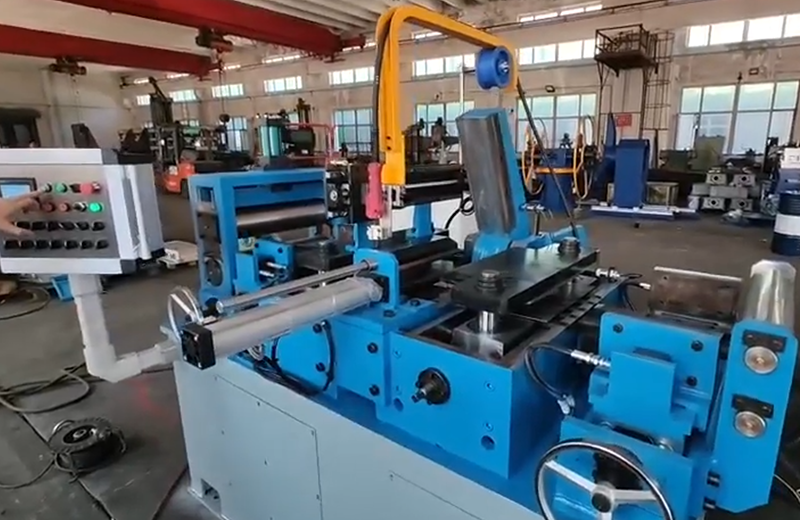
1. The Role of a Decoiler and Straightener in Tube Mill Lines
Before strip enters the forming section, it must be unwound from a coil and flattened to remove memory from coiling. A decoiler and straightener performs two distinct but integrated functions:
Decoiling (uncoiling) – Rotates the coil at controlled speed while maintaining constant back tension to prevent telescoping or edge damage.
Straightening (levelling) – Passes the strip through alternating rollers that plastically deform it to achieve flatness within ≤1 mm per meter (typical requirement for high-frequency welding).
Without a properly matched decoiler and straightener, tube mills experience up to 15% scrap from shape defects. For automotive structural tubes or pressure lines, this is unacceptable. SANSO engineers each system to the customer’s coil dimensions and material grade.
2. Technical Classification: Types of Decoiler and Straightener Configurations
Depending on floor space, coil weight, and required line speed, decoiler and straightener systems fall into three common architectures.
2.1 Single-Arm Mandrel Decoiler with Pinch Roll Straightener
This entry-level configuration uses a single expanding mandrel (hydraulic or mechanical) to support the coil. A separate pinch roll unit pulls strip through a 5‑roll or 7‑roll straightener. Suitable for:
Coil weight: up to 5 tons.
Strip width: 100–600 mm.
Thickness: 1.0–4.0 mm.
Line speed: ≤30 m/min.
Limitation: Requires manual coil loading and cannot handle heavy-gauge high-strength steel (HSS).
2.2 Double-Coned Decoiler with Integrated 9‑Roll Straightener
For medium-duty lines (5–15 ton coils), a double-cone decoiler provides better coil centering and reduced run-out. The straightener is frame‑integrated with driven work rolls (top and bottom). Features:
Hydraulic cone expansion for quick coil ID gripping.
Back tension control via DC motor or vector drive.
Straightener roll diameter: 80–120 mm.
Backed-up by support rolls to prevent shaft deflection.
This configuration is common for ERW tube mills producing 20–100 mm OD pipes.
2.3 Heavy-Duty Hydraulic Decoiler with 17‑Roll Precision Leveller
For high-strength steel (yield > 600 MPa) or thick plates (6–25 mm), a decoiler and straightener uses a double-mandrel turret head (one coil unwinds while another is loaded) and a separate heavy-duty leveller with cassette-type roll cartridges. Benefits:
Coil weight up to 30 tons.
Automatic coil centering and coil ID clamping.
Straightener with 17 rolls (9 top / 8 bottom) with individual hydraulic gap adjustment.
Flatness tolerance: ≤0.5 mm per meter.
SANSO provides heavy-duty systems with ABB or Siemens drives and PLC control.
3. Industry Pain Points and Engineering Solutions for Decoiler and Straightener Systems
Even well-designed decoiler and straightener lines face recurring operational issues. Below are four documented problems and field-proven countermeasures.
3.1 Coil Telescoping and Edge Damage
When the decoiler’s expansion mandrel does not perfectly center the coil, or when back tension is insufficient, wraps slide axially (telescoping), damaging strip edges. This causes weld porosity and poor edge alignment. Solutions:
Install an electro-hydraulic edge position control (EPC) system with ultrasonic sensors to keep the strip centered.
Use a drag brake with closed-loop tension feedback (load cell at straightener entry).
Specify a decoiler with 4‑segment expansion mandrel (for heavy coils) rather than 3‑segment.
A 2023 retrofit on a 12‑ton line reduced edge damage from 8% to 0.5% after installing EPC and tension control.
3.2 Residual Strip Curvature (Camber and Crossbow)
Insufficient straightener roll penetration or incorrect roll diameter leads to residual curvature that causes twisting in the forming section. Measurement: place a 2 m straightedge on the strip; gap should be <1 mm. Fixes:
Increase number of straightener work rolls from 7 to 9 or 11.
Adjust roll intermesh (typically 2–4 mm for 3 mm strip) using digital readouts.
For thick strips, use a 5‑roll pre-leveller before the main straightener.
A decoiler and straightener with individual roll adjustment can correct crossbow down to 0.3 mm/m.
3.3 Strip Slippage and Inconsistent Feed Rate
If the pinch roll pressure is uneven or the straightener rolls lack sufficient drive torque, the strip slips during acceleration, causing misfeeds into the forming mill. Solutions:
Use two driven straightener rolls (instead of only one) with independent servo motors.
Apply polyurethane-coated pinch rolls for higher friction coefficient (μ=0.5 vs. 0.2 for steel on steel).
Implement a dancer arm or loop pit to decouple decoiler speed from mill demand.
Many modern decoiler and straightener lines now use AC vector drives with encoder feedback to maintain slip below 1%.
3.4 Downtime for Coil Changeovers
Manual coil loading can take 15–20 minutes per coil, severely limiting OEE. Solutions:
Turret-type double-cone decoiler: load a new coil while the other is unwinding.
Coil car with hydraulic lift and rotation.
Automatic strip end welding station (for continuous operation).
SANSO provides fully automatic coil change systems reducing downtime to under 3 minutes per coil.
4. Key Technical Specifications: How to Select a Decoiler and Straightener
When evaluating a decoiler and straightener, request the following performance data from the manufacturer:
Coil weight capacity – 3T, 5T, 10T, 20T, 30T (choose based on mill utilization).
Strip width range – 50–1600 mm (standard).
Strip thickness range – 0.5–25 mm (depending on roll design).
Yield strength of material – up to 800 MPa for heavy-duty models.
Maximum line speed – 40 m/min (standard), 80 m/min (high-speed).
Straightener roll count – 5, 7, 9, 11, 17 rolls (more rolls = better flatness).
Straightener roll diameter – 60–180 mm (larger rolls for thicker strip).
Control system – Manual (handwheel), semi-automatic (PLC with HMI), fully automatic (closed-loop levelling).
For mills producing welded tubes for boilers or structural applications, a straightener with backup rolls (to prevent roll deflection) is mandatory. SANSO offers FEA-optimized frames with 0.05 mm/m deflection under full load.
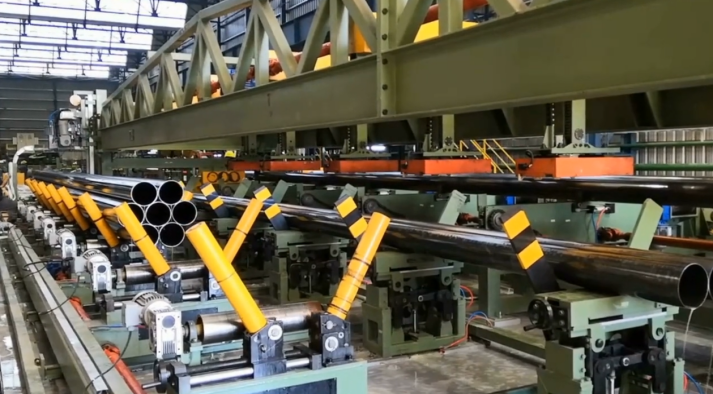
5. Integration with Downstream Equipment: Forming, Welding, and Cut-off
A decoiler and straightener does not work in isolation. Its output strip quality directly affects:
Roll forming stations – Flat strip reduces springback and uneven forming forces, extending roll life by 30%.
High-frequency induction welding – Edge wave (up/down) causes uneven current concentration, leading to cold welds or burn-through. Straightened strip keeps edges aligned within 0.2 mm.
Sizing and straightening sections – Residual camber from poor levelling cannot be fully corrected by downstream straighteners.
Flying cut-off saws – Strip length accuracy depends on consistent feeding; a slipping decoiler introduces length variations > ±2 mm.
Field data from a 2” ERW tube mill showed that upgrading from a 5‑roll to a 9‑roll decoiler and straightener reduced weld seam rejections by 42% and improved roundness tolerance from ±0.5 mm to ±0.2 mm.
6. Maintenance Best Practices for Decoiler and Straightener Systems
To achieve 10+ years of reliable service, follow this maintenance schedule:
Daily – Check hydraulic oil level, listen for bearing noise in straightener rolls, inspect coil expansion segments for wear.
Weekly – Lubricate all greasing points (mandrel slides, roll bearings, gearboxes). Measure straightener roll parallelism with a dial gauge (tolerance ≤0.05 mm).
Monthly – Check pinch roll pressure uniformity using a pressure-sensitive film. Replace worn roll covers.
Quarterly – Calibrate tension load cells. Inspect gear couplings for backlash.
Annually – Regrind straightener work rolls to restore surface finish (Ra 0.8 µm). Replace hydraulic hoses.
SANSO supplies spare part kits and provides remote diagnostic support for all its decoiler and straightener models.
7. Performance Comparison: Entry-Level vs. Industrial-Grade Systems
The following table compares typical metrics from two decoiler and straightener classes used in tube mills.
| Parameter | Entry-Level (7‑roll) | Industrial Grade (17‑roll, SANSO) |
|---|---|---|
| Max coil weight (T) | 5 | 30 |
| Strip thickness range (mm) | 0.8–4.0 | 2.0–25.0 |
| Flatness after straightening (mm/m) | ≤1.5 | ≤0.5 |
| Line speed (m/min) | 25 | 60 |
| Changeover time (manual/auto) | 15 min | 3 min (auto turret) |
| Control system | Manual handwheel | PLC + touchscreen + remote |
| Price range (USD) | 12,000 – 25,000 | 65,000 – 150,000 |
For mills running three shifts, the industrial-grade decoiler and straightener pays back in less than 18 months through reduced scrap and higher OEE.
8. Future Trends: Servo-Driven and IoT-Enabled Decoiler and Straightener
Modern manufacturing lines integrate Industry 4.0 features into the decoiler and straightener:
Servo-electric straightener rolls – Individual roll torque control for adaptive levelling, reducing energy consumption by 30% compared to hydraulic systems.
Vibration monitoring – Accelerometers on straightener roll housings predict bearing failures.
Edge wave detection via laser profilometer – Closed-loop adjustment of roll intermesh in real time.
Remote diagnostic portal – Allows SANSO technicians to optimize parameters from off-site.
Early adopters report a 22% reduction in unscheduled downtime after implementing predictive maintenance on their decoiler and straightener lines.
Frequently Asked Questions (FAQ) About Decoiler and Straightener Systems
Q1: What is the difference between a decoiler and a straightener? Can they be separate units?
Q2: How many straightener rolls do I need for my tube mill?
Q3: Can a decoiler and straightener handle stainless steel coils?
Q4: What safety features are required on a decoiler and straightener?
Q5: How to request a custom decoiler and straightener from SANSO?
Need a reliable decoiler and straightener for your tube mill? SANSO manufactures custom systems with heavy-duty frames, servo drives, and PLC control. Request a free line audit and coil flatness assessment. Fill out the form below to receive a technical proposal and price list.
Send Decoiler & Straightener Inquiry →
© 2026 SANSO – Precision coil processing equipment for tube and pipe mills. Performance data from field installations and internal testing.
Related News
More -

Decoiler and Straightener: Essential Tools for Your Welded Tube Mill
Every welded pipe or tube you see starts as a coiled strip of metal. But before that strip can be formed, welded, and cut, it needs to be properly pre ...2026-01-13View More -
Decoiler and Straightener Systems: Optimizing Coil Feeding for High-Speed Tube and Pipe Welding Lines
In any tube mill, roll forming line, or slitting operation, the first critical stage is coil handling. A poorly performing decoiler and straightener ...2026-04-09View More
-
 Why Does Your Tube Mill Cut-Off Leave Burrs? An Engineering Analysis
 -
 Ferrite Core Service Life and Function in Tube Mills
 -
 How Much Zinc Wire Is Used for 1 Ton of Galvanized Tube
 -
 Why Does Your Tube Mill Require a High-Quality Saw Blade HSS for Clean Cuts?
 -
 How Tube Mill Equipment Flips Rectangular Tubes Before Stacking